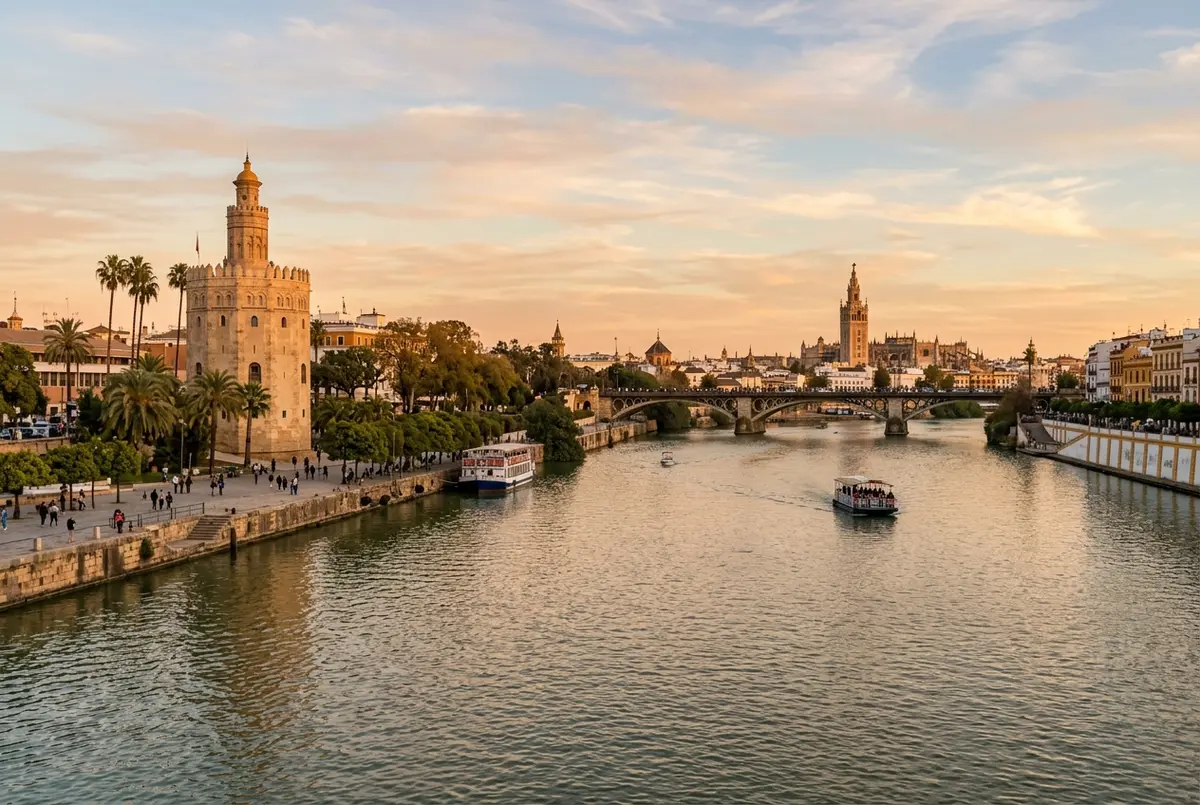
What river runs through Seville? The Guadalquivir, and it’s not a minor detail: this river is the entire reason the city sits where it does, and why Seville became one of the most important ports in European history for a few centuries. I’d go as far as saying you can’t really understand Seville’s old town, its wealth, or its architecture without understanding this river first.
Most visitors notice the river without really registering it, it’s just “the water near the Torre del Oro” on a city map. I think that undersells it. Once you know the backstory, a cruise down this stretch of water reads completely differently.
What River Runs Through the City of Seville?
The Guadalquivir is the river running through Seville, flowing roughly through the middle of the historic center and separating the old town from the Triana neighborhood on the opposite bank. It’s the longest river entirely within Andalusia and the fifth longest on the Iberian Peninsula. I’d say it’s one of the few rivers in Europe where you can trace a direct line from its geography to a city’s entire economic history.
Where Does the Guadalquivir Start and End?
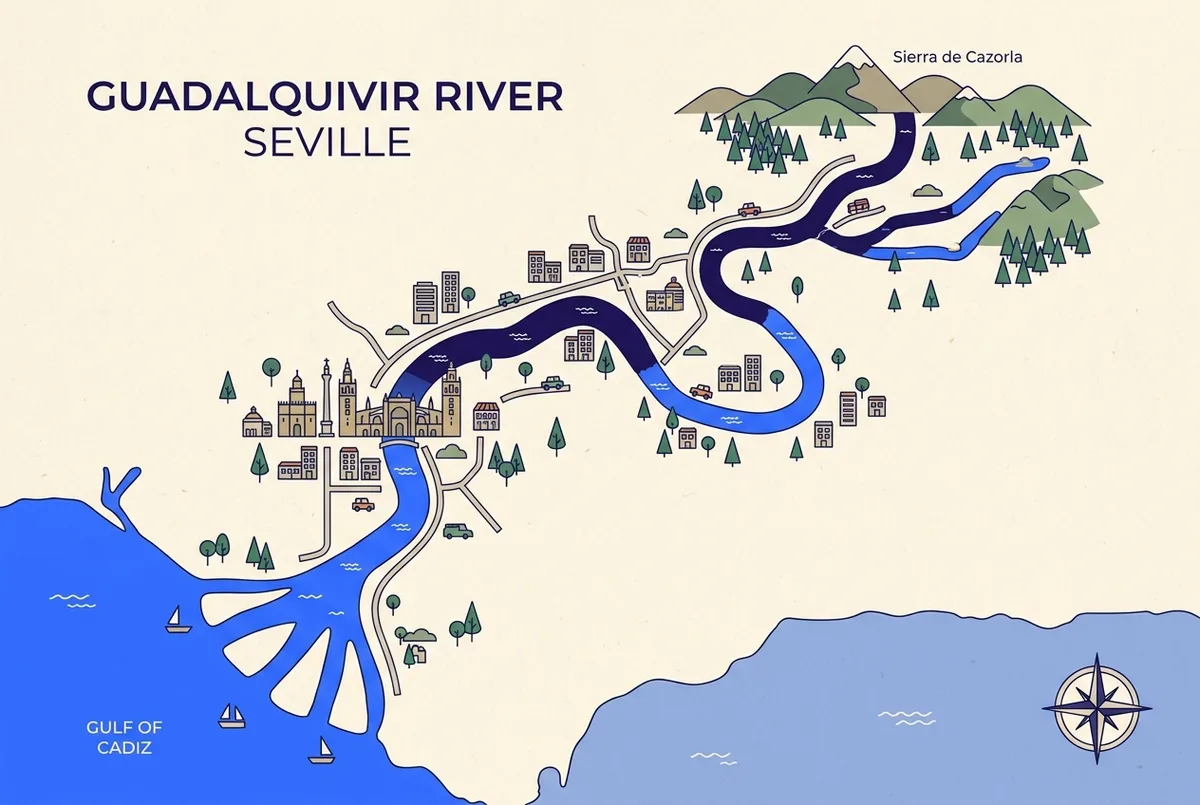
The river rises in the Sierra de Cazorla mountains in Jaén province, winds roughly 657 kilometers across Andalusia, and empties into the Gulf of Cádiz near Sanlúcar de Barrameda, not far from Seville itself. That stretch near the mouth is wide and tidal, which is part of why ocean-going ships could once sail all the way inland to Seville, a detail that mattered enormously to the city’s history. I wouldn’t call the river dramatic in the way an alpine river is, it’s calmer and flatter for most of its length, which is exactly what makes a sightseeing cruise through the city such an easy, low-key experience.
Why Does Seville’s River Matter So Much Historically?
Because Seville could be reached by seagoing ships sailing up the Guadalquivir from the Atlantic, the city became Spain’s main gateway to the Americas after 1492, holding a monopoly on New World trade for roughly two centuries through the Casa de la Contratación. I’d argue this single geographic fact, that a river this far inland was deep and wide enough for ocean ships, explains more about Seville’s wealth, architecture, and layout than almost anything else you’ll read about the city.
Ferdinand Magellan’s expedition departed from Seville along this river in 1519, and I think that fact alone says something about how central the Guadalquivir was to the Age of Exploration, not as a backdrop, but as the actual departure point.
Why Is It Called the Guadalquivir?
The name comes from the Arabic “al-wādī al-kabīr,” meaning roughly “the great river” or “the great valley,” a legacy of the centuries when Islamic rule shaped much of Andalusia’s language, agriculture, and place names. I find it a nice detail that the river’s name has stayed essentially unchanged for over a thousand years, through Roman, Islamic, and Christian Seville alike, even as the city built and rebuilt around it.
What Does This Mean for a River Cruise Today?
It means the stretch you’d actually sail on a modern sightseeing cruise is the same calm, historically loaded water that once carried ships bound for the Americas. The eco cruise departing near the Torre del Oro covers almost exactly this stretch, the tower itself was built in the 13th century partly to help guard and control river traffic into the city. I’d genuinely recommend reading a bit of this history before you book, it changes a pleasant boat ride into something closer to seeing the backbone of the city’s entire story.
Did the River’s Importance to Seville Ever Decline?
Yes, gradually, and I think this part of the story gets left out of most quick explanations. Over the 17th and 18th centuries, silt buildup made the Guadalquivir harder for the largest ships to navigate all the way to Seville, and some of the colonial trade role eventually shifted downstream toward Cádiz, which had a deeper, more reliable harbor. I wouldn’t call this a dramatic single event, it was a slow, decades-long shift rather than the river suddenly becoming unusable, but it’s a big part of why Seville’s golden age as a port city has a clear historical arc rather than continuing indefinitely in the same form.
I find this detail genuinely useful context for a cruise today. You’re sailing a river that built an empire’s wealth, then slowly lost that specific role to a sister city on the coast, and still kept the architecture and the old riverside docks to show for it.
Is the Guadalquivir Still Used for Shipping Today?
Not the way it once was. Seville’s port still handles some river traffic and ocean cruise ships dock further downstream near the coast rather than in the city center itself, but the volume of commercial shipping through the historic heart of the city is nowhere near what it was during the colonial trade era. I’d say the river’s role has shifted from economic engine to the thing that makes a sightseeing cruise possible in the first place, which honestly feels like a fitting second act for a waterway this historically loaded.
Does the River Look Different in Different Parts of the City?
Yes, genuinely. The stretch past the Torre del Oro and the old town is the busiest and most historic, flanked by centuries of architecture on one bank and the lively Triana neighborhood on the other. Further out toward La Cartuja, the river feels more open and modern, with newer bridges and Expo 92 era buildings replacing the dense historic skyline. I’d say that contrast is part of what makes a full sightseeing cruise interesting, you’re not watching one unchanging riverbank for an hour, the character of the water genuinely shifts as the boat moves along it.
Do People Confuse the Guadalquivir With Other Water Features in Seville?
Yes, fairly often, since Seville has more than one notable water feature close together. The Plaza de España boat rides run on a park moat, not the Guadalquivir at all, and I’d keep the two firmly separate in your head before booking anything. The actual river is the wide, open stretch of water running past the Torre del Oro, not the decorative moat a few minutes’ walk away.
Where Should You Go to Actually See the River Up Close?
The riverside promenade near the Torre del Oro is the easiest spot, and it’s also where most sightseeing cruises depart from. The full landmarks guide names everything you’ll see along the water, from the watchtower itself to the bridges connecting the old town to Triana, if you want to know what you’re looking at before you book a boat.
I’d also say the river genuinely looks different depending on when you see it. The best time of day to cruise it and the best season for a comfortable trip both affect the light and the crowd, even though the river itself obviously stays the same.
Is It Worth Booking a Cruise Just to See the River?
I think so, yes, especially once you know what you’re actually looking at. A short cruise doesn’t just move you past pretty buildings, it puts you on the exact water that built the city’s wealth and launched one of history’s most consequential sea voyages. Checking real reviews before booking is still a sensible habit, but I wouldn’t hesitate on the premise itself, the river is the real draw here, not a gimmick dressed up as one. The fuller rundown on whether river cruises are worth it here covers the safety and value side of that decision if you want more before booking.
Frequently Asked Questions
What is the name of the river that flows through Seville?
The Guadalquivir, Andalusia’s longest river at roughly 657 kilometers, running from the Sierra de Cazorla mountains to the Gulf of Cádiz.
Why was the Guadalquivir so important to Seville’s history?
It allowed ocean-going ships to sail inland to Seville, making the city Spain’s main port for trade with the Americas for roughly two centuries.
Does the Guadalquivir river run all the way to the ocean?
Yes, it empties into the Gulf of Cádiz near Sanlúcar de Barrameda, a tidal stretch that once let seagoing ships reach Seville itself.
Is the Guadalquivir the same water you see at Plaza de España?
No, Plaza de España’s boats float on a separate park moat. The actual Guadalquivir runs past the Torre del Oro, a short walk away.
Can you cruise the actual Guadalquivir river in Seville today?
Yes, sightseeing cruises run along the same stretch of river that once carried ships to and from the Americas, departing near the Torre del Oro.
My honest take: once you know this is the river that built Seville’s fortune and launched Magellan’s voyage, a short cruise down it stops being a generic boat ride and starts feeling like the most direct way to touch the city’s actual history.
book the seville boat tour on this very river →